सोमबार १६ कात्तिक, २०८३,
Mon, 02 Nov, 2026
सोमबार १६ कात्तिक, २०८३,
Mon, 02 Nov, 2026

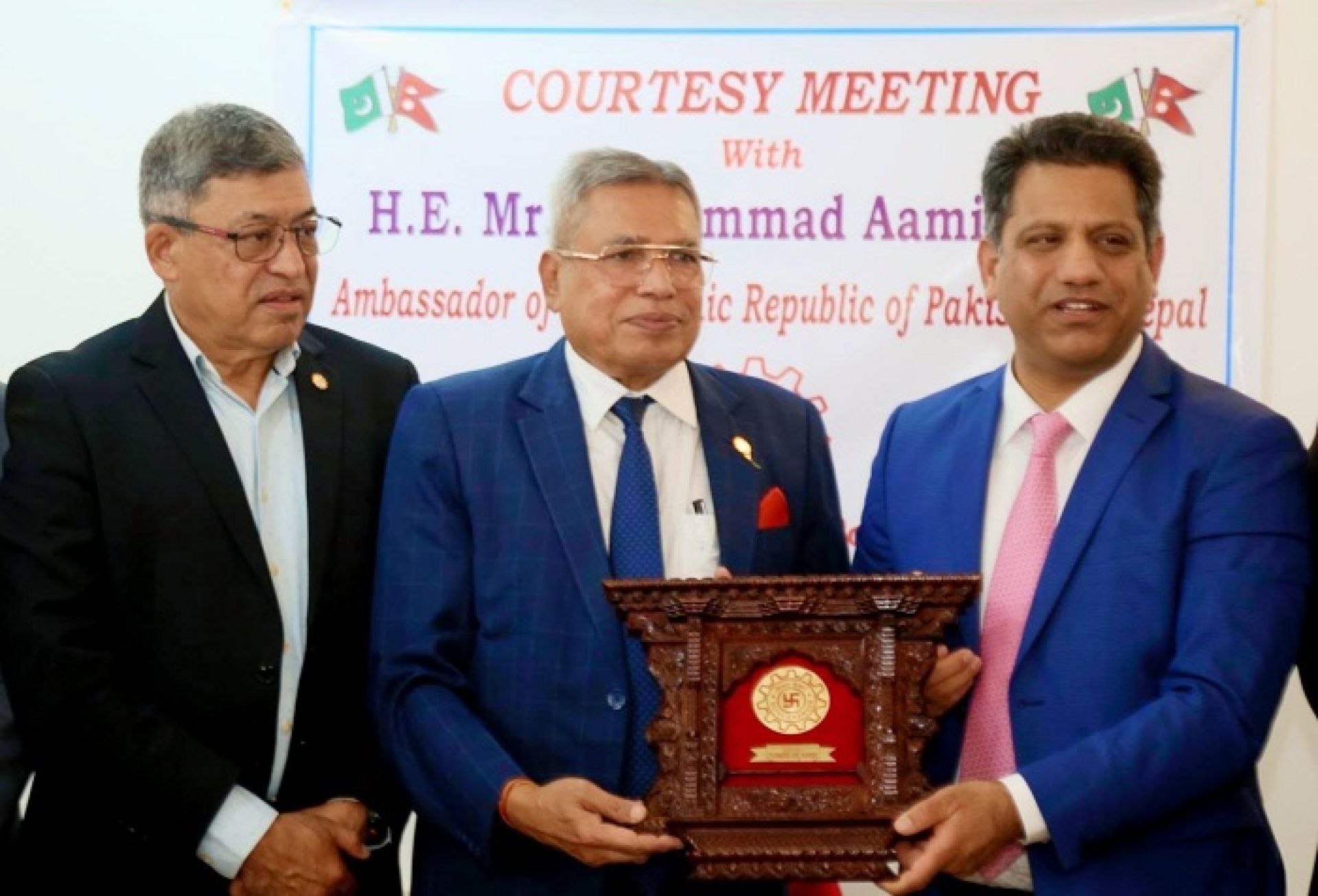

Kathmandu : Emphasis was placed on further strengthening the long-standing diplomatic and friendly relations between Nepal and Pakistan through economic cooperation, trade, investment and business partnerships.

A courtesy meeting between Nepal Chamber of Commerce President Kamlesh Kumar Agrawal and Ambassador of Pakistan to Nepal, Mohammad Aamir Khan, held on monday at the Chamber Bhawan, featured extensive discussions on enhancing trade and investment between the two countries.
During the meeting, President Agrawal noted that Nepal and Pakistan have maintained friendly relations since the establishment of diplomatic ties on March 20, 1960, and stated that the long-standing relationship should now be transformed into tangible economic achievements. Although a bilateral trade agreement was signed in 1982 and a Joint Economic Commission was established in 1983, trade activities have not expanded as expected, he said.
He emphasized the need to move beyond formal agreements and diplomatic dialogue and expand direct business-to-business (B2B) contacts, market access, joint investment, and business partnerships between the private sectors of both countries.
Agrawal highlighted the potential for exporting Nepali tea, large cardamom, ginger, medicinal herbs, essential oils, and processed agricultural products to Pakistan. He stated that there are good prospects in the Pakistani market if the quality, packaging, branding, certification, and regular supply of Nepali products can be ensured.
Similarly, noting Pakistan's experience in pharmaceutical manufacturing and the textile industry, he expressed the view that Nepal could benefit from such expertise and explore cooperation in pharmaceuticals, medical equipment, healthcare services, technical training, research, and joint investment.
He also identified information technology, artificial intelligence (AI), digital services, startups, tourism, and cultural exchanges as important areas of Nepal-Pakistan economic cooperation. He stated that immediate cooperation could be advanced in information technology and tourism, particularly because geographical distance does not pose a major barrier in these sectors.
Ambassador Khan stated that Pakistan attaches special importance to its relations with Nepal and noted that although the two countries share historical, cultural, and people-to-people ties, economic relations have not expanded as expected. He said that reconnecting economic relations with Nepal was one of the key priorities of his tenure.
Highlighting the significant potential of the young workforce in both countries, he emphasized the need to connect the ideas, technology, and entrepreneurship of the new generation with economic cooperation. He expressed the view that in the changing global economy, economic diplomacy, digital technology, and effective connectivity networks are more important than geographical distance. During the meeting, Ambassador Khan expressed his sorrow over the loss of lives and damage to infrastructure in Rasuwa and surrounding areas caused by the recent floods in Nepal.
On behalf of the Government and people of Pakistan, he expressed solidarity with the Nepal Chamber of Commerce, Nepali business community, and affected communities.
During the meeting, both sides expressed their commitment to advancing cooperation between Nepal and Pakistan in trade, investment, tourism, information technology, agriculture, the pharmaceutical industry, and the expansion of air and land connectivity, among other areas.
Senior Vice President of the Nepal Chamber of Commerce, Dipak Kumar Malhotra, among others was also present at the meeting.


सञ्चार रजिष्ट्रारको कार्यालय दर्ता प्रमाणपत्र नंः
००१७६/०७९-०८०